
How Cross Dock Warehouses Help Prevent Supply Chain Delays: Speed, Flexibility, and Strategic Positioning
Cross-dock warehouses are the supply chain's safety valve — preventing small delays from cascading into costly disruptions. Here's how they work.
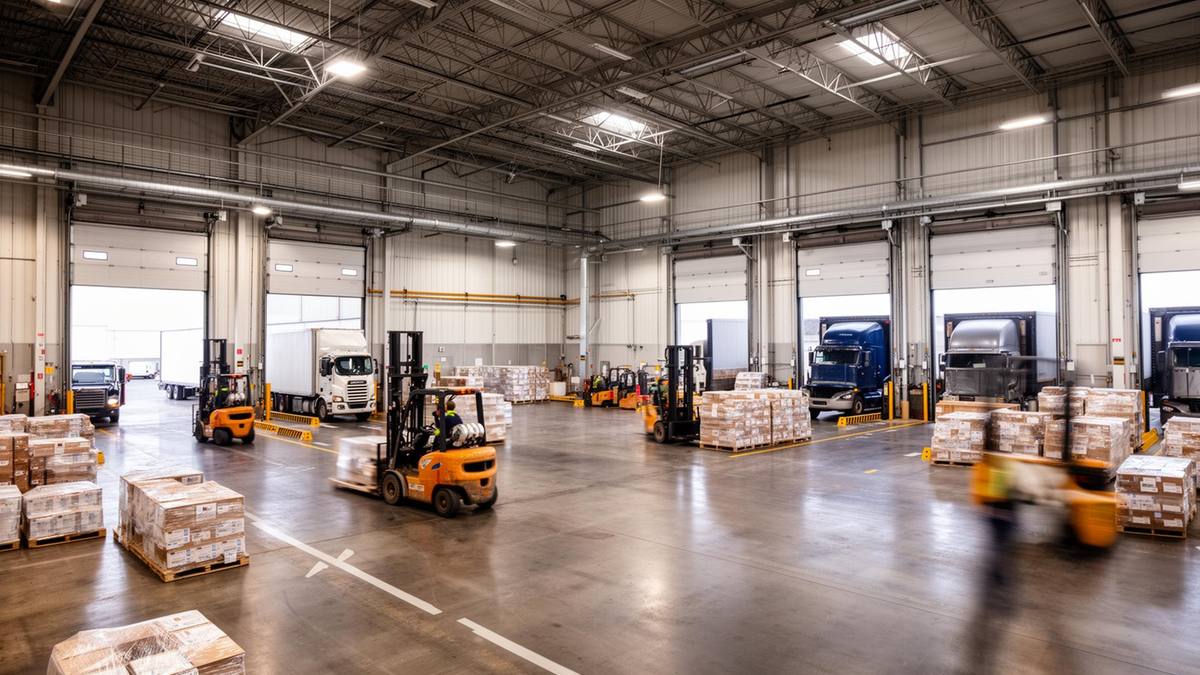
Supply chain delays don’t start as disasters — they start as small disruptions that cascade. A 4-hour delay at a border crossing becomes a missed delivery window, which becomes a rescheduling fee, which becomes a detention charge, which becomes a customer service failure. The companies that prevent these cascades are the ones that build cross-dock capability into their supply chain network.
The Cascade Problem in Modern Supply Chains
Modern supply chains are optimized for efficiency, which means they have very little slack:
- Just-in-time manufacturing means production lines stop when parts are late
- Tight delivery windows at retailers mean loads rejected for being 30 minutes late
- Driver HOS limits create hard stops that can’t be negotiated
- Cross-border complexity adds documentation and inspection variables
- Weather and traffic are beyond anyone’s control
When any one of these factors creates a delay, the lack of buffer capacity means the delay propagates through the entire chain.
How Cross-Dock Warehouses Break the Cascade
Cross-dock facilities serve as buffer points in the supply chain — places where freight can be absorbed, reorganized, and redistributed without the multi-day delays of traditional warehousing:
1. Freight Absorption
When a delay occurs upstream, cross-dock facilities absorb the impact:
- Receive freight even when the downstream destination isn’t ready
- Stage it safely until delivery windows reopen
- Eliminate driver detention by freeing the truck immediately
2. Load Optimization
Cross-dock enables real-time load optimization:
- Consolidate partial loads from multiple origins into full truckloads
- Break bulk shipments into smaller deliveries for regional distribution
- Sort and sequence freight for delivery route optimization
3. Quality Intervention
Cross-dock provides a checkpoint for freight quality:
- Inspect incoming loads for transit damage before delivery
- Restack shifted pallets and re-wrap damaged loads
- Catch documentation errors before they cause receiver rejections
4. Mode Shifting
When one transportation mode fails, cross-dock enables shifting:
- Transfer between carriers when the original can’t complete delivery
- Split loads for different final destinations
- Stage for alternative routing when primary routes are disrupted
Cross-Dock vs. Traditional Warehousing for Delay Prevention
| Characteristic | Traditional Warehouse | Cross-Dock Facility |
|---|---|---|
| Dwell time | Days to weeks | Hours |
| Setup cost | High (racking, slotting) | Low (dock-to-dock flow) |
| Flexibility | Lease-bound | Per-use pricing |
| Response time | 24-48 hours to arrange | Same-day |
| Ideal for | Planned inventory | Disruption recovery |
Strategic Cross-Dock Positioning: The Midwest Advantage
The most effective cross-dock networks are positioned at freight corridor intersections. Toledo represents one of the strongest positions in the Midwest:
- I-75 corridor — connects Detroit/Canada to Cincinnati/Southeast
- I-80/90 corridor — connects Chicago/West to Cleveland/East Coast
- One-day reach to 60%+ of the US and Canadian population
- Detroit proximity — 45 minutes to the region’s busiest freight market
- Lower operating costs than major metro cross-dock facilities
Industries That Depend on Cross-Dock for Delay Prevention
Automotive Manufacturing
Just-in-time production means any parts delay stops the line. Cross-dock facilities near auto plants provide emergency parts staging and rapid redistribution when primary shipments are delayed.
Retail and E-Commerce
Missed delivery windows at distribution centers trigger chargebacks and vendor penalties. Cross-dock staging prevents a late shipment from becoming a missed window.
Cross-Border Freight
US-Canada freight is subject to customs delays, documentation holds, and border congestion. Cross-dock facilities near border crossings provide pre- and post-border staging.
Food and Beverage (Dry Goods)
Product shelf life means delays have direct financial impact. Cross-dock keeps product moving and reduces time in the supply chain.
How Sam’s Toledo 3PL Prevents Supply Chain Cascades
Our network of Toledo cross-dock facilities is positioned as a strategic buffer point on the I-75/I-80 corridor:
- Same-day dock access — no appointment required for disruption recovery
- Multiple facilities across Toledo, NW Ohio & SE Michigan for simultaneous load/unload operations
- Secure yard space for trailer staging when plans change
- Pallet restacking and rework — fix problems before they reach the receiver
- Load consolidation and deconsolidation — optimize every truck that leaves
- Photo documentation — provide visibility to all supply chain stakeholders
- Flexible pricing — pay for what you use, no long-term commitment
When supply chain disruptions hit, our Toledo cross dock warehouse turns potential cascading failures into manageable detours.
FAQ
How do cross-dock warehouses prevent supply chain delays?
Cross-dock facilities serve as buffer points that absorb disruptions — receiving freight when destinations aren't ready, freeing drivers immediately, and enabling load optimization, quality checks, and carrier transfers to keep freight moving.
What's the difference between cross-dock and traditional warehousing for disruption management?
Cross-dock is designed for speed (hours, not days), requires minimal setup, offers per-use flexibility, and can respond same-day. Traditional warehousing is better for planned inventory storage but too slow for disruption recovery.
Why is Toledo a strategic location for cross-dock operations?
Toledo sits at the intersection of I-75 and I-80/90, providing one-day reach to 60%+ of the US and Canadian population. It's 45 minutes from Detroit and offers lower costs than major metro facilities.
What industries benefit most from cross-dock delay prevention?
Automotive manufacturing (just-in-time parts), retail/e-commerce (delivery window compliance), cross-border freight (customs staging), and food/beverage (shelf life protection) are the primary beneficiaries.
Related reading
Emergency Freight ·
How Cross Dock Warehouses Solve Freight Emergencies: Speed, Flexibility, and Zero Wasted Time
When freight emergencies strike, cross-dock warehouses provide the speed and flexibility brokers need. Here's how they work and when to use them.
Emergency Freight ·
Trailer to Trailer Freight Transfers Explained: How Cross-Dock Warehouses Keep Loads Moving
Trailer-to-trailer freight transfers are one of the most common cross-dock operations. Here's how they work, when they're needed, and what to look for in a transfer facility.
Detroit Freight ·
Detroit Freight Overflow: Why Shippers Use Toledo Warehouses Instead of Paying Metro Detroit Premiums
Metro Detroit warehouse space is expensive and scarce. Smart shippers are using Toledo's I-75 corridor for overflow storage at 15–25% lower rates.